

What is the WCAG?
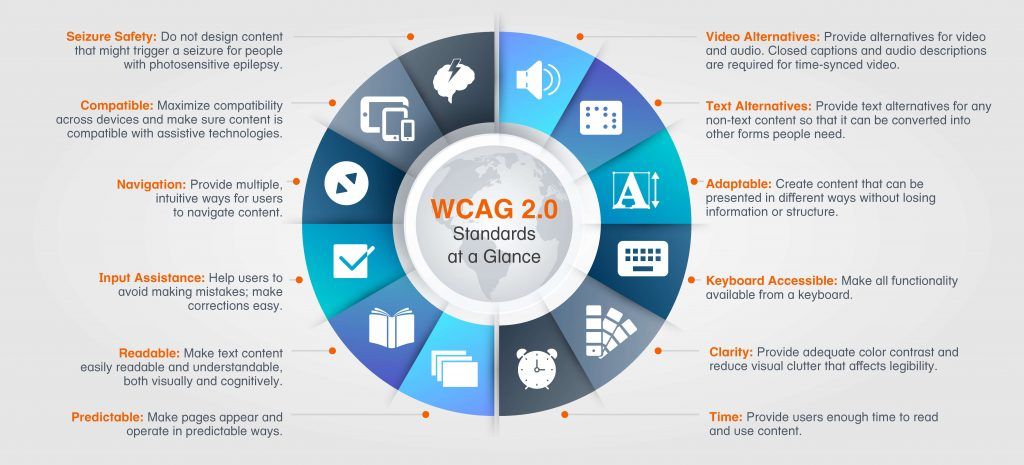
WCAG stands for the Web Content Accessibility Guidelines. The Web Content Accessibility Guidelines (WCAG 2.1 guidelines) are arguably the most influential protocols shaping web accessibility policy.
Why should I care about WCAG Compliance?
To really understand why the WCAG matters so much, you need to know who is behind them. The WCAG was created by the World Wide Web Consortium, known as the W3C. The W3C was founded in October 1994 in MIT’s Laboratory for Computer Science (MIT/LCS). Founding members included top scientists, and by late 2019, the organization has over 440 members including leaders from business, nonprofit organizations, universities, government entities, and relevant industries.
The development of web accessibility standards was one of the earliest issues to be addressed by W3C founders in the mid-1990s. It would take several years however before a coherent set of standards would be published. In 1998, a 25-point document on best web accessibility practices was put forth by the Trace R&D Center at the University of Wisconsin, a collaborator of the W3C. This served as the basis for the first version of WCAG published the following year in 1999. Almost ten years later at the end of 2008, the WCAG 2.0 was released. Today, the updated version WCAG 2.1 is the W3C’s standard on web accessibility and the one we follow today.
W3C originally focused on standardizing web protocols so that websites and web tools would be compatible with each other. Every W3C standard is reviewed several times, tested, and analyzed before it’s approved by members. Usually, W3C standards have 3 levels of compliance, from A to AAA.
The 4 principles of WCAG
The full WCAG 2.1 is incredibly long and complex, with many different points and requirements, but they’re all based on 4 essential principles: perceivable, operable, understandable, and robust. Some believe that there's a WCAG 2.1 checklist but in reality, it is more complex than that. The first step for achieving WCAG Compliance, It's to understand Its principles:
- Perceivable - this refers to the ways that users perceive content online through their senses of sight, sound, and touch. This includes issues like captions for videos, text that can be adjusted for contrast, color, text size and spacing, font, and similar factors that make it easier to read.
- Operable - operability means the ways that someone can use the site. It’s particularly relevant to people with motor disabilities, weak muscles, injured limbs, etc. An operable site needs to be navigable entirely by keyboard, sight-assisted navigation, and other alternatives to a classic mouse.
- Understandable - understandable sites are easy for everyone to understand. They don’t use a lot of technical terms or complex jargon, don’t have complicated instructions that are difficult to follow, and have consistent directions that won't confuse readers.
- Robust - there are two factors for a robust site:
- Using clean HTML and CSS code that meets recognized standards
- Being compatible with assistive tools that people with disabilities use to browse online
How does WCAG affect accessibility laws?
The WCAG isn’t a set of laws that can be enforced, but many governments have adopted it as the standard for their accessibility regulations. Below is a short overview of international accessibility laws that rely on WCAG guidelines. Effectively, WCAG compliance is the best means for achieving compliance with most worldwide legislations.
WCAG related regulation in the United States
In early 2018, the updated version of Section 508 of the Rehabilitation Act of 1973 came into effect. Section 508 requires that every online platform run by federal bodies or any organization that receives federal funding must be accessible for all users. Under updated rules, these sites have to comply with the WCAG 2.0 Level AA.
When individuals in the US have sued businesses with websites that aren’t accessible, under the Americans with Disabilities Act (ADA), courts have required those websites to reach WCAG 2.0 Level AA compliance. You'll often hear the term WCAG ADA Compliance. That means that the best way to comply with ADA is by following the WCAG.
WCAG related regulation in the European Union
In 2010, EU officials adopted WCAG 2.0 Level AA as mandatory for all official EU sites, and expanded that to all public sector web platforms and to include WCAG 2.1 in 2016. The E.U. also adopted WCAG 2.0 as the standard for the new European Accessibility Act, EAA, which will become law in 2025.
WCAG related regulation in Canada
In June 2019, the Accessible Canada Act (ACA) was passed into law by the federal government in Ottawa. The ACA requires a large number of public and private sector sites to become accessible according to WCAG.
Several provinces have also passed accessibility laws, such as the Accessibility for Ontarians with Disabilities Act of 2005, AODA, the Accessibility for Manitobans Act (2013), and the Nova Scotia Accessibility Act (2017), which all use the WCAG as the standard for compliance.
WCAG related regulation in Australia
The Australian Disability Discrimination Act (DDA) was enacted in 1992 to eliminate barriers that prevent individuals with disabilities from accessing real-world workspaces. Over time, the governmental Human Rights Commission and other authoritative bodies in Australia interpreted the DDA to include online services. Official recommendations “strongly encourage” all businesses and services to meet WCAG 2.1 standards to avoid violating the DDA.
In 2010, the Australian government’s Web Accessibility National Transition Strategy required all Australian government agencies to meet WCAG 2.0 Level AA.
To summarize
Despite the fact that WCAG has no legal authority, it has achieved global recognition as the most important set of accessibility standards and is enforced to varying degrees by most major countries.